


I’m not known for getting upset. My closest friends likely wouldn’t remember seeing me visibly angry even once. Also, my closest friends have been with me on crazy scenes, in suspect houses, on the side of the road, out of town with everything going wrong, in schools, in booking and detention centers, and dealing with lying liars. When necessary, I have the capacity to be very serious. It’s like in the movie Ronin when Spence (Sean Bean) asks, “You ever kill anybody?” Sam (Robert De Niro) replies, “I hurt somebody’s feelings once.”
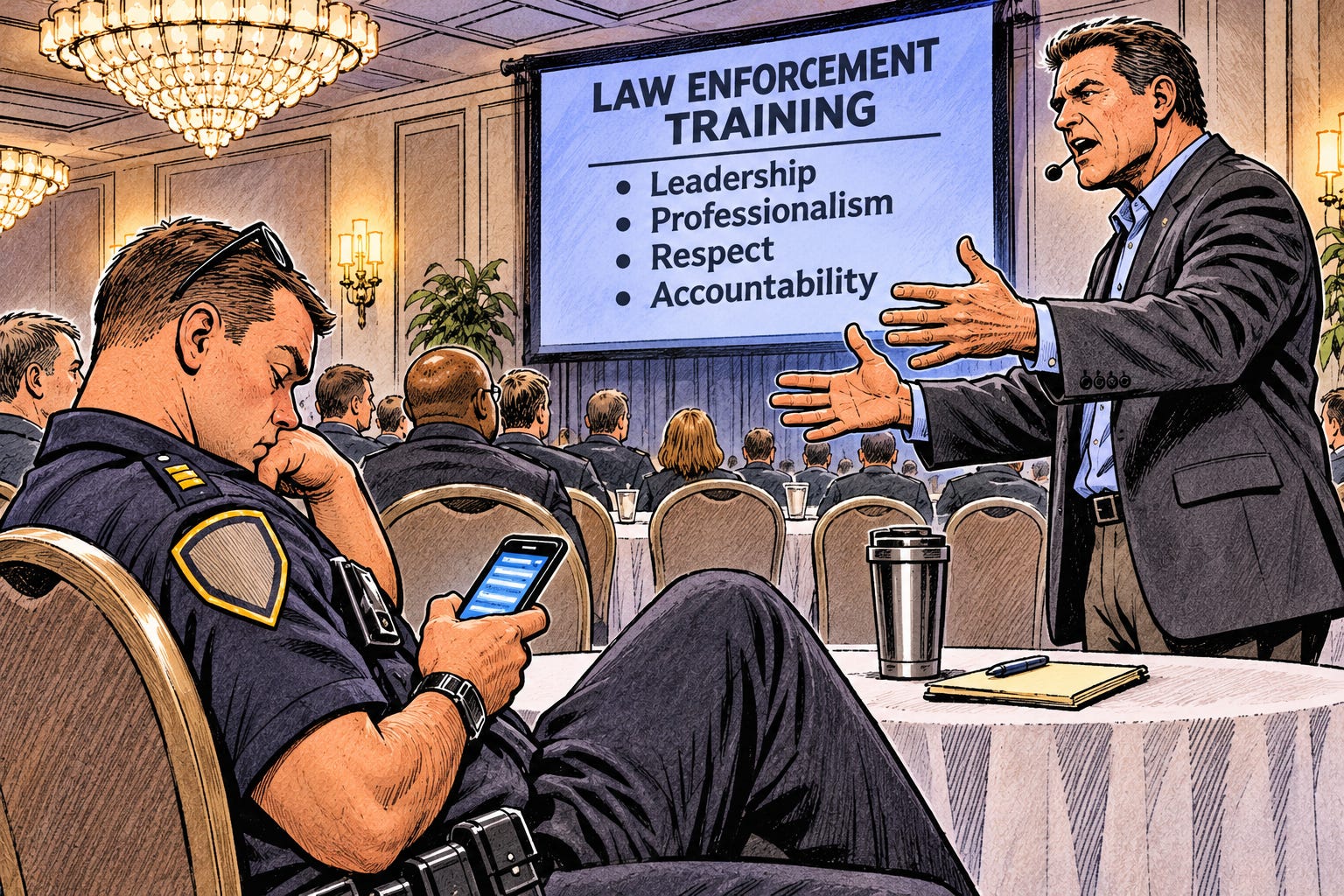
I’m irritated today over something in the recent past. A couple of months ago, I saw a video of one of the premier law enforcement speakers, addressing a group of law enforcement managers. The lieutenant or captain sitting up front, a couple of feet from the speaker, was engrossed in his phone and was disregarding the speaker. His posture let you know that he wasn’t handling an emergency.
In our first responder universe, there are trainers and speakers who, depending on the topic and the presenter, aren’t telling you anything new. Not this speaker. In other words, it takes far more effort to intentionally ignore him than to pay attention. He commands a premium presentation fee. He tells you what no one else will tell you. One of the presenter’s key points is that the first responder community accepts unacceptable behavior and then wonders why folks are so messed up.
Depending on how many people were in the ballroom, the agency has invested between $200 to $600 dollars per officer to attend while taking cops off the street for up to two days. In some agencies, the overtime required to maintain minimum manning exceeds the travel and training cost.
It’s time for two solutions
The first solution is accountability in the agency. Let everyone who applies for training know the agency expectation for decorum and participation. Training policy must include an off-site dress code, the expectation that the trainee is present before the class commences and released after it ends.
There is a greater leadership issue present here. The officer disrespecting the presenter, let’s call him Captain Lazybones, didn’t adopt this posture and attitude after breakfast that morning. If his supervisor were to receive a complaint call on his conduct, the surprise would only be that someone called him out, not that he exhibited this behavior. Captain Lazybones, and everyone like him, gets away with this on the street, in the corridors of the agency, in public meetings and at the conference table. She or he is your agency’s reputation.
From the time I was a teenager working in retail stores, I witnessed people getting fired on the spot for their conduct. Argue with a manager, pick up your last check at the window. If there was an issue with your apparel, they would give you an hour, one time only, to go home and change. If you were having a bad day, you could have a bad day on your own time, but not while you were working.
Police culture was the opposite. When I started at the agency, I was shocked at what people got away with. There were a lot excuses. That’s why we are dealing with these issues today.
The second solution rests on the training provider. During the registration process, a required field is the supervisor (or proxy) of the trainee. If they are the chief, that would be the 24/7 contact information of either the city manager or the mayor. Everyone ranked lower than that on the roster must have a valid supervisory contact should a complaint be necessary.
If trainers and training companies can get serious about this, and just change that one requirement in registration, perhaps a registration box, an agreement that the agency contact has the authority to initiate disciplinary process when an officer wastes scarce training resources.
Leaders can’t set it and forget it
What an embarrassment to send officers, of any rank to training, and have them disrespect the trainer that the agency has both invested and sacrificed to furnish the training. Like so many other issues in law enforcement and the broader first responder community, it is obviously a leadership issue. The presenter said it best. Our professions accept unacceptable behavior and then questions why so many of us are struggling. Captain Lazybones is not the disease. He or she is the symptom. Set the standard, write it into policy, and enforce it the first time, not the fifth. A standard not enforced is just a suggestion.
Leaders, supervisors, and agency heads should give themselves a simple test. Contact the last three or four outside trainers with a list of your employees who attended and seek honest answers about their behavior and decorum in class. If you are anxious about the answers and you can accurately predict what you anticipate hearing, you have already recognized the problem. Today is the day to start fixing it.
Please keep all peace officers in your prayers.
Roland Clee served a major Florida police department as a Community Service Officer for more than 26 years. His career included uniformed patrol, training, media relations, intelligence, criminal investigations, and chief’s staff. He writes the American Peace Officer newsletter, speaks at public safety, recruiting and leadership conferences and helps local governments and public safety agencies through his business, CommandStaffConsulting.com.
His work is frequently featured on LawOfficer.com, the only law enforcement owned major media presence in the public safety realm.
For media interviews and podcast appearances, click here: http://bit.ly/40pT3NS