


Human Performance vs. Armchair Expectations
Is tailgating dangerous? We find consensus on this. Driving by a traffic accident, some are quite obviously cause and effect, even for those who have had no training other than the material to pass a driver license exam.
Every driver has experienced the stress and anxiety of a tailgater on their rear bumper. I’m guilty of judging the tailgater through the reflection of my rear-view mirror and spin through speculations of how she or he is likely not insured.
However, the driver license handbook suggests impossibly high following distances with suggestions on estimating distance a professional surveyor or real estate agent couldn’t achieve. The most practical advice which works at all speeds is the two second rule. If that’s new to you, here is how it works: as the vehicle in front of you passes a marker, your vehicle stays two seconds behind. It takes .75 seconds to realize the car in front of you has slowed or applied their brakes. This gives you 1.25 seconds to get your foot on the brake.
But here is the real question: Why does a 19-year-old driver, during the peak reflexes of their life, have dramatically more rear end collisions than a 79-year-old who has lost most of their reflex speed. The answer is human performance tempered by training and experience. That is the answer to a great many things.
When Courts and Media Confuse Opinion for Science
Two recent events have brought these factors into the forefront. The police training company Force Science Institute was criticized by an Eastern Kansas media outlet trying to portray them as discredited. This was based on other reports, where another media outlet - who also had not seen the training or the lesson plans - had quoted some critique, by a judge and a former prosecutor. The closest anyone got to a real claim was that while testifying, Dr. Bill Lewinski, founder of the Force Science Institute, replied to the prosecutor’s question during cross examination:
“You have never testified on behalf of a citizen who was shot, killed, or injured by the police since 2003, have you?” McGinn asked. “We’ve never been asked, so the answer is no,” Lewinski said.
I have been connected on social channels for some time with Force Science leaders Von Kleim and Brian Baxter and found their commentary nothing but insightful and thoughtful. Based on everything that I have read from each of them, including Chief Baxter during the years prior to joining Force Science, there have been nothing but reasonable and sound well-founded perspectives. My review of videos available online reveal nothing but reasonable science at the most practical level.
The recent Kansas news article quotes a judge from more than a decade ago stating: In a 2013 ruling on a case in which an officer used force, California U.S. District Court Judge Jesus Bernal called Force Science research “nonscientific gobbledygook” and wrote that it enjoys “little or no acceptance within the relevant scientific community.”
Judges have the right to their own opinion, but when broadcasting from the bench, they should be accountable to every voter in their district. Steve McAllister, former US Attorney who has presented possibly a record nine cases before the United States Supreme Court referred to Force Science Institute as ‘snake oil salesmen.’
While the world, the defense attorneys, and media convince the general public that they have the capacity to evaluate ‘officer performance’ the sane and reasonable limit the expectations to measurable ‘human performance.’ Long story short, even the best work within their limits. Force Science Institute has a distinguished track record, even five years ago being featured in the IACP media and touting 30 peer-reviewed published studies.
Two years ago, I saw something similar out of New Jersey. Kevin D. Walsh, who was serving as acting comptroller, is a civil rights attorney known more for his work at conference podiums than in courtrooms—where selective facts are used strategically, assumptions about motives are made, and the public is encouraged to take sides before any real understanding of the case can develop.
The police training company doing business as Street Cop Training had secured conservative commentator Tomi Lahren as their Atlantic City keynote speaker. Was that the trigger for Walsh? We’ll never know. When the acting comptroller found this out many months later, he delivered the most left-centric report to the New York Times prior to its official release. Walsh went to great lengths to portray Street Cop Training as endorsing unconstitutional policing, while every authentic exposure of their work displays the highest regard for the United States Constitution.
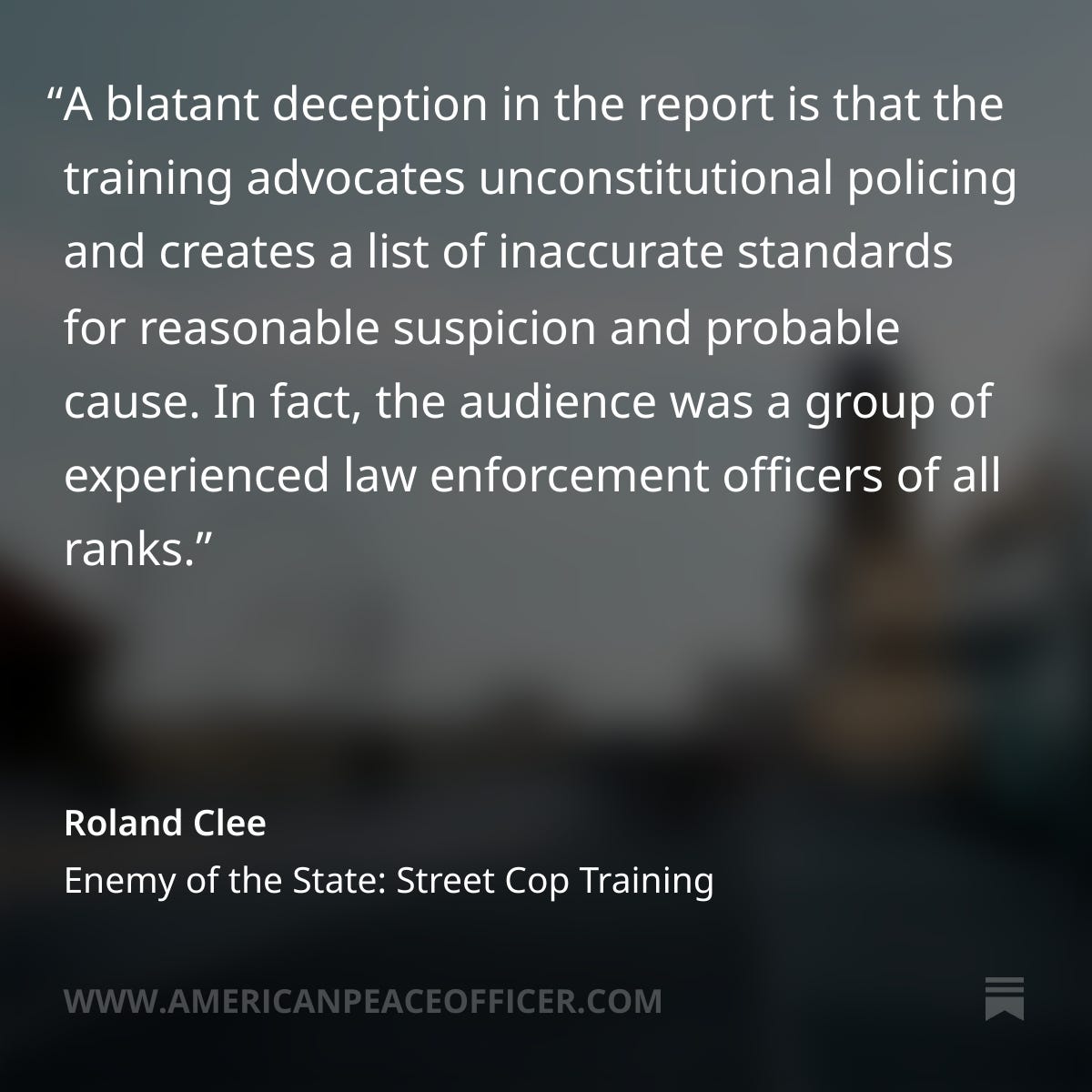
Walsh and his team practiced deceptive video editing presenting to any audience that icebreakers were the curriculum and that holding captive the attention of the officers attending the conference was only to be in humorless puritan fashion. In an irony beyond irony, the leaders of Street Cop Training were producing the next level advanced training that New Jersey cops hadn’t been offered by New Jersey Police Training Commission since its formation in 1961.
The very fact that Street Cop Training was in business, and departments were ‘using taxpayer dollars’ to equip high initiative officers was to fill the gap that the state POST had failed to supply for 60 years.
The Myth of De-Escalation
Police academic research, usually NIJ funded, is rarely consequential except in the forensic sciences. You could subscribe, as I did for years, to the National Institutes of Justice library additions weekly emails. The more technical and scientific the article, the more benefit it appeared to present to the forensic community. The most concerning aspect was how many taxpayer-funded studies wound up behind very expensive paywalls. Studies that helped midnight shift officers were non-existent for years.
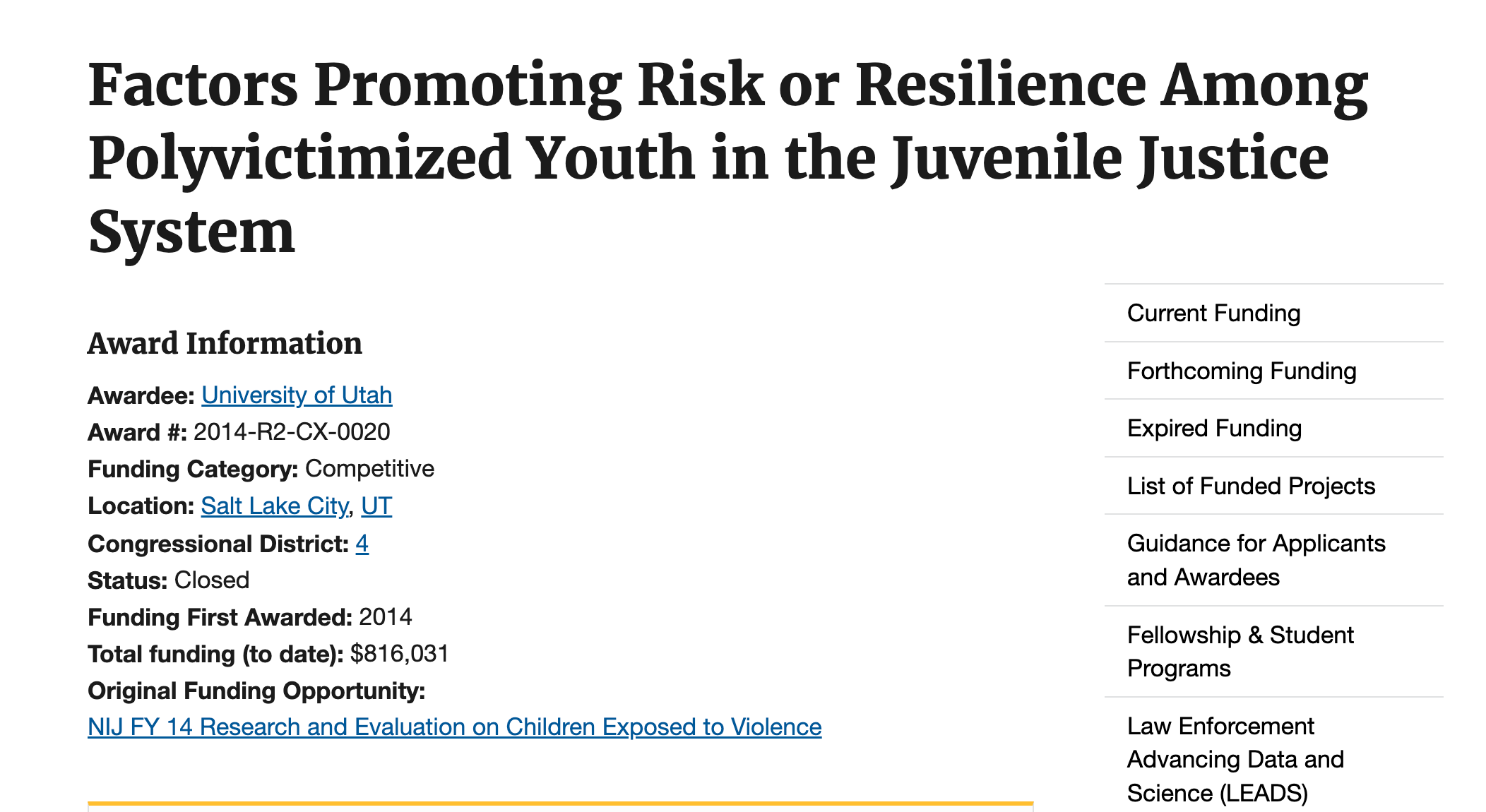

Then, on the extremely rare occasion where you have the George Mason University meta-study on police body worn cameras that shatter the myths of the vendors claims of behavior change of suspects and officers. Commonly know as the Hawthorne Effect, that observation creates a modification in behavior. It works for a while, as in jail calls, but it proves that one of the chief claims of BWC, behavior modification are revealed to have no benefit, and ultimately absolutely nothing changes.
The most important research revelation of 2025 came from my friend Dr. Travis Yates. De-escalation has been a household word in the public sphere for some time. But to quote Tucker Carlson’s most overused phrase: ‘What is that?’ There was a huge assumption that this was ‘common knowledge’ and there would be training to – well, to put this bluntly, to have the police de-escalate themselves. Dr. Yates yanked the curtain back on the whole charade.
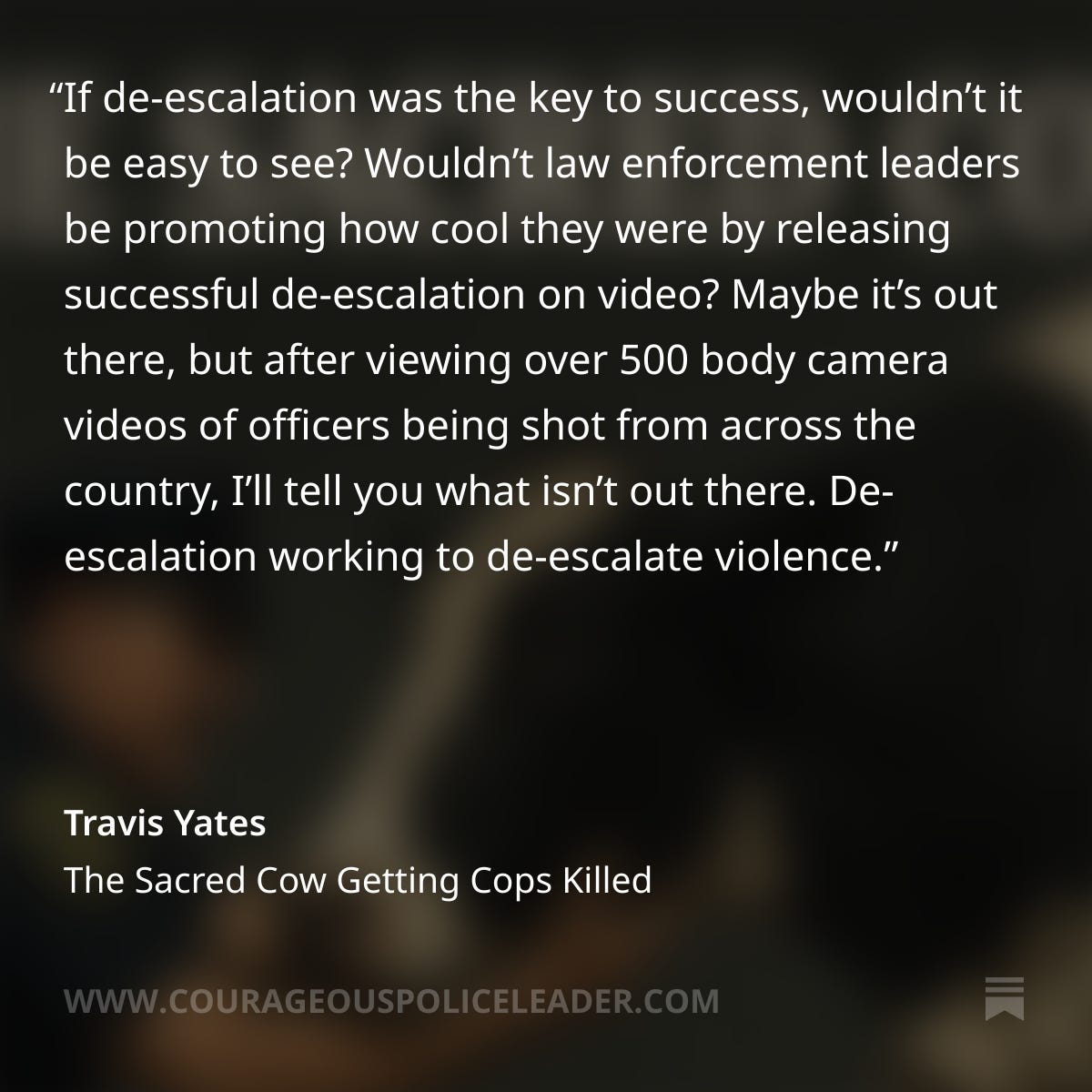
Dr. Yates offers a human performance course, Seconds for Survival, that uses human models both inside and outside of law enforcement. He bases this on broadly accepted research on all sides of the political spectrum. The data, the same data gathered by DOJ conducted studies, as well as National Institutes of Justice funded stories studies that were not taxpayer funded, provides the clear parameters on what performance is to be expected from suspect and officer. His “course blends behavior pattern analysis with practical survival strategies so officers can anticipate and prevent violence rather than merely react to it.”
It is too easy to forget that these trainings did not begin spontaneously. They arose out of a need and a gap that exists in most states’ curricula. These courses provide exactly what the most ardent police critics demand: more lifesaving training. It is time that we embraced the groundbreaking studies and quit burying the best of authentic research. Ignoring that truth doesn’t make policing better. It only makes tragedy more likely.
Please keep all first responders and their families in your prayers.
Roland Clee served a major Florida police department as a Community Service Officer for more than 26 years. His career included uniformed patrol, training, media relations, intelligence, criminal investigations, and chief’s staff. He writes the American Peace Officer newsletter, speaks at public safety, recruiting and leadership conferences and helps local governments and public safety agencies through his business, CommandStaffConsulting.com.
For media interviews and podcast appearances, click here: http://bit.ly/40pT3NS
References:
https://www.wtvr.com/news/local-news/chesterfield-police-force-science-charles-byers-july-2024?utm
It’s the illusion of explanatory depth at work - the belief that watching a body-camera video equates to understanding the complex, time-compressed, legally constrained, and physiologically stressful reality of police response to resistance decision-making. That confidence usually evaporates when people are asked to explain those decisions in detail or perform within the same constraints.
The challenge for policing is that we spent years bringing proverbial “knives to gunfights” in our engagement with media and other public narratives. We assumed shared incentives and mutual understanding, when in reality, media, academia, and advocacy operate under very different pressures and priorities. Sometimes those align with public safety. Sometimes they don’t.
This won’t change until police leaders address it from within, by clearly explaining why we do what we do and by holding our own accountable to professional standards when we fall short. Public trust depends on both.
As your piece rightly notes, body cameras are only one fragment of a much larger picture. They don’t change behavior; they reveal it, often exposing gaps in training, equipment, and preparation. And yet, across millions of daily interactions, officers overwhelmingly resolve encounters lawfully and professionally. That’s not accidental. It’s the result of good people operating within demanding systems, making rapid decisions under uncertainty, in service of the public.
Extremely well written as usual. The old phrase "walk a mile in their shoes" should be modified for LEO's to "walk a dark alley in their shoes". Thanks for the informative article using fact based science.