

Editor’s Note: The following guest article is republished with the author’s permission. I know its message deserves a wider audience within the law enforcement community.
You can find the original article and subscribe to the author’s publication here. Dr. Travis Yates has earned my highest respect.
Near the end of the New Testament is a book that warns of false teachers. Granted, Jude, Christ’s brother, was discussing the church, but as a Christian, it’s hard not to see parallels to what I have seen in law enforcement over the last decade. These false teachers, discussed thousands of years ago, were most dangerous because they came from inside the church and could fool many.
“For certain people have crept in unnoticed...” Jude 1:4(a).
This is exactly what law enforcement has faced, and while it may have started with those outside the profession, it is those inside who have implemented policies that harm officers.
The Policy of Hesitation
I’ve talked a lot about hesitation killing officers and train others to avoid tragedy by covering pre-attack indicators and behavioral cues in an evidence-based course called FOCUS (Field Observable Cues for Unknown Situations), but you don’t need the training to see it.
You know it because you feel it, and if you’ve watched even a few videos of police use of force online, you see officers hesitate. Several reasons explain this, but the most troubling are the policies that cause it.
And one of the most dangerous policies I have seen is when leaders implement a mandatory report whenever an officer unholsters or points their weapon. To the uninformed, this seems to make sense. But those who do the job every day, they know exactly what it’s doing.
How It Started
A policy mandating a use-of-force report because an officer anticipated danger but didn’t use force would have seemed ridiculous when I started my career, but outside forces have been bent on creating more danger for a job that already had too much.
The Police Executive Research Forum introduced the idea in 2016 when it published its guiding principles, saying agencies “should capture and review reports on the pointing of a firearm.” In nauseating fashion, the IACP issued a 2017 concept papersuggesting that pointing a firearm should be classified as force and thus needed reporting. In 2020, Campaign Zero’s #8Can’tWait platform included “Comprehensive Reporting” whenever an officer pointed a firearm.
Agency leaders jumped all over the recommendations, and while most have removed any mention of #8Can’tWait after their research came under scrutiny by anyone with a working brain, many of the recommendations remain in policy today.
Where We Are
While some may say the policy of documenting the unholstering of a weapon is a good thing, designed to hold officers accountable, I would ask: accountable for what? Citizens can file complaints anywhere, including online. Body cameras are watching cops at all times. The only reason to mandate reporting is to encourage officers not to touch their weapon.
By design, the policy encourages hesitation or inaction, and the policy is working. Prior research confirms the danger of burdening an officer with paperwork, saying that “filling out a form is one reason people tend to accept whatever default they are given (Johnson & Goldstein, 2003; Thaler & Sunstein, 2009).
If that default is waiting to be attacked before acting, so be it.
In the most recent 5 years of LEOKA data, just 22% of the officers who were killed in the line of duty were able to shoot back. That leaves 78% of our officers who were killed in the line of duty with no chance of survival. And before you scream ambush, most weren’t.
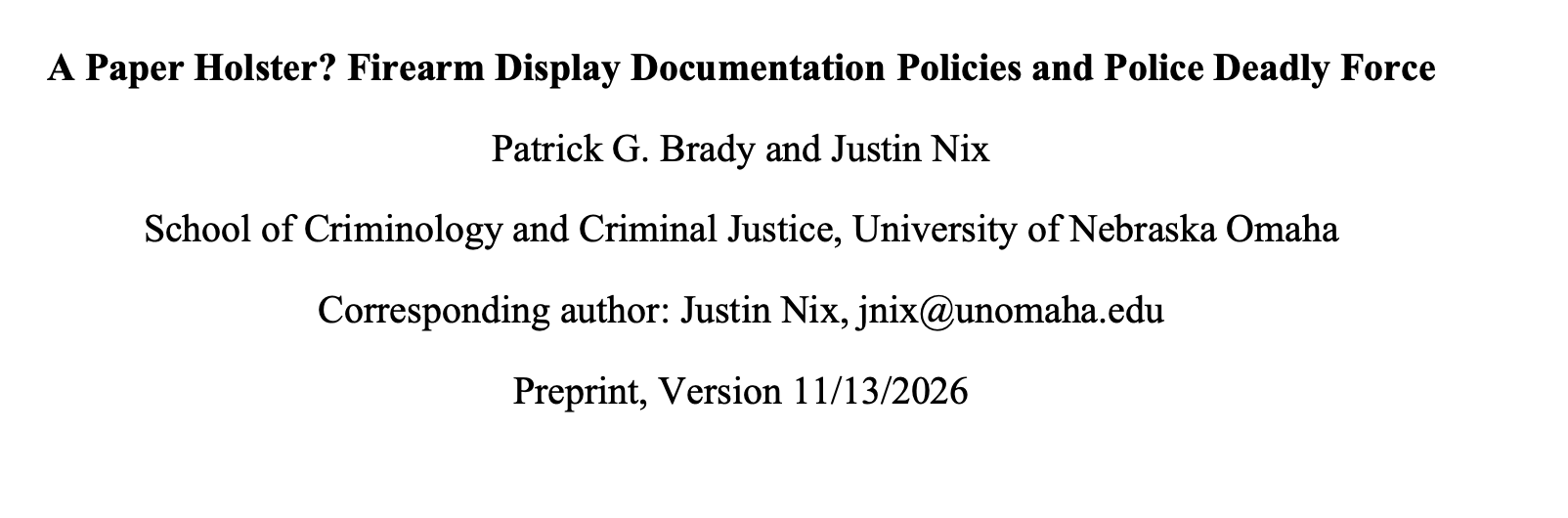
In a pre-print study, Patrick Brady and Justin Nix compared 135 agencies that adopted a firearm-display documentation policy with 250 agencies that reported no policy across 42 states. After police agencies began requiring a report every time an officer draws or points a gun, the officer casualty rate in those agencies rose by 20% of their pre-policy average, compared with agencies that did not adopt the policy.
Some may say that the increase in officer deaths had nothing to do with the policy recommended by PERF, IACP, activist groups, and adopted by over half of police leaders in the United States. Maybe not, but the activism hurting cops doesn’t stop at this policy. Use-of-force policy reforms are hurting more cops and increasing use of force, and New Jersey is the latest example of what PERF-recommended de-escalation training is doing to the profession, as officer injuries increased and use of force rose 9.5% after every officer was mandated to take the training.
To be clear, these studies are not blaming the sacred cow of “police reform” for the increase in officer deaths, assaults, and use of force, but if the reverse were true, do you think the reforms would get the credit?
At least Brady and Nix (2026) had the courage to acknowledge their concern, recommending that agencies monitor officer safety after adoption, stating that total officer casualties rose 20% in the agencies that adopted the policy, but they “find no evidence that display policies increased officer deaths; these data cannot rule out moderate increases in them.”
This is academia, and I appreciate their work, but I am a practitioner who happens to be inside academia, and my viewpoint, along with officers I speak to daily, is much different.
Failed Police Reform
I won’t find many outside the profession or behind a desk with collar brass willing to acknowledge much of what I’m saying, but will they ignore what Brady and Nix (2026) stated clearly in their study? While they remained somewhat neutral on blaming the policy for officer deaths, they saw no changes in police shootings.
Which begs the question: why the policy?
It’s clear to those actually doing the job, and I stated it earlier. The policy is designed to make cops hesitate, full stop.
Unfortunately, it’s working exactly as intended.
Dr. Travis Yates retired as a commander with a large municipal police department after 30 years of service. He is the author of “The Courageous Police Leader: A Survival Guide for Combating Cowards, Chaos & Lies.” He has taught his risk management and leadership seminars to thousands of professionals worldwide. He graduated from the FBI National Academy, holds a doctoral degree in Strategic Leadership, and founded FOCUS, the first research-based framework designed to keep officers alive before the threat is identified.