



Murders are down. For the record, I am happy about that. My wise friend Keith Graves of Christian Warrior Training points out that the only crime stats you can trust are car thefts and deaths. Some reports on 2024 crime statistics are saying the murder rate is at the lowest point since 1900. There is a whole lot of data out there to analyze and interpret. However, we need to take a moment to appreciate that young people today are in a safer world than I have ever lived.
Drug overdose deaths are also, thankfully, down and continuing to decline. Henry Grabar reports in The Atlantic that a protester’s sign in Seattle read:
‘HEY SPD, ... CRIME IS DOWN 20 PERCENT, AND YOU HAD NOTHING TO DO WITH IT.’
The taunt was glib, but it hinted at a profound question about the nature of public safety in American cities. After a pandemic-era rise in murders commonly attributed to a lack of policing, Seattle recorded fewer homicides in 2025 than in 2019, despite a much-smaller police force.
It’s true. Unfortunately, we are not looking at a solution where reducing the police is the causation for a reduction in crime. Just like shark bites are forever pegged to ice cream sales, correlation does not always prove causation.
Attrition as an Explanation No One Wants to Say Out Loud
In a recent conversation with Chief Patrick Flannelly (ret.) on the The Coptimizer Podcast we discussed the solemn consequences of the fatal drug overdose crisis over the past years and how, due to Fentanyl and many other deadly drugs, property crime and other categories will be decreased.
This is what I said last year on this topic:
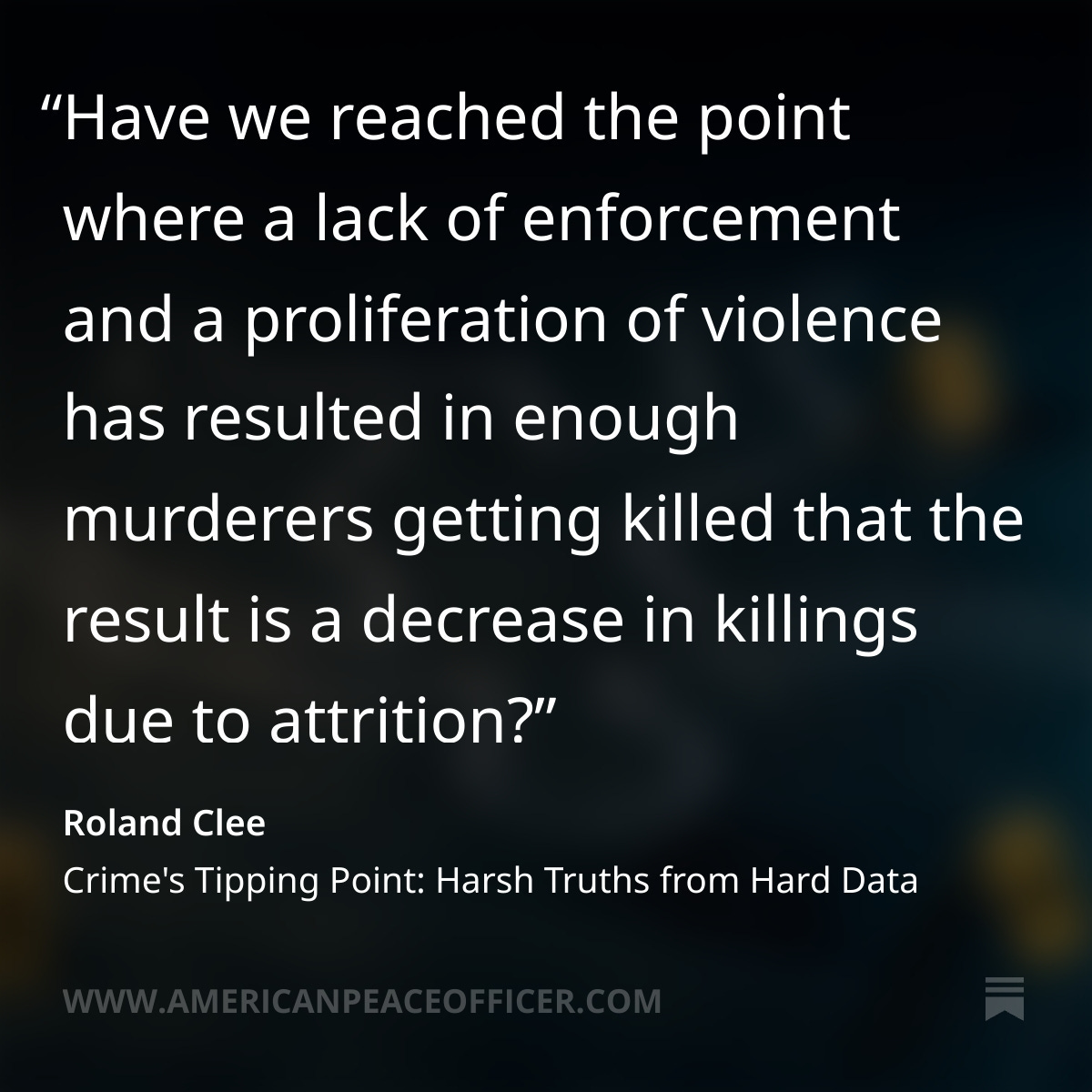
Check out the post here:
Crime's Tipping Point: Harsh Truths from Hard Data

(Thank you for being a valued subscriber to American Peace Officer! This publication has become the primary means of support for my family. By upgrading to a paid subscription, you'll do exactly what I do with the Substack creators I proudly support by investing in them. Your support ensures that I can continue delivering high-quality, ad-free content while expanding reach and impact.)
Revisiting community college statistics class, winning the lottery does not change the odds that you might win next week. You are not bumped to the bottom of statistical probability but instead your probability remains exactly the same for the next drawing (to the chagrin of other players).
That isn’t the same in the world of addiction and substance abuse. There is a finite segment of the population that wakes up planning to intentionally deprive others of their money and property for their own benefit. This population has been the most significantly devastated by the fatal drug overdose crisis. It is a consequence of attrition.
It is similar with murderers. One thing that Lifetime movies get right, you likely won’t be murdered randomly. Sadly, murder investigations that I have assisted with include intimate partners, brothers, and my last major case was framed as a beef between rappers, but they were also first cousins.
One recorded the profound mournful lyrics ‘when people die, you don’t see them no more.’
But the tie between victim and offender relationship in murder cases is substantially tighter than property cases. This again provides the most plausible explanation for the decrease in murders, that due to years of neglect since a low in 2014, failures in law enforcement’s ability to intervene created an escalation that has peaked and has now fallen. Unlike the lottery maintaining and expanding the number of players, there are no replacement murderers when one gets killed or long term imprisonment.
Demographics, risk aversion, and a safer, but stranger, generation
Another critical component to be considered is that the 2025 graduating class was the numerical peak of my lifetime and not projected to reoccur during my lifespan. Projections are that class size will decline for several decades to come. One of the top five school districts in the country is considering consolidating eight primary schools due to below threshold enrollment. Two other major school districts in Florida are consolidating schools, and while school choice options are a driver, many of these schools would still be in play if they hit fifty percent occupancy.
Author Abigail Shrier on Substack as The Truth Fairy is writing her third book, this time on why Generation Z are not engaging in pre-marital reproductive behavior, where young people are not engaging in risk of any sort, even sexy risk. Don’t worry, she will include all the factors including digital devices, social substitution, and ingrained safety-ism as contributors, but it is profound to consider the degree that these forces are shaping our future.
But the question remains, what is the status and future of law enforcement considering reports like this. In 2002, I was on the Homicide Squad when we had a five-month period where every single one of our attempted murder victims survived. Muscles were sprained ‘while we were patting ourselves on the back’, but as soon as murders picked up again, the line was ‘murders are not preventable.’ I’ll debunk that in a future article where courage, risk, and boldness saved a lot of lives and families.
During the last 13 years we have seen the exodus of not just law enforcement officers from the profession, but law enforcement officers and their families. When I was selected to go to police academy 32 years ago, I wasn’t one of the ‘naturals’ but they weren’t hard to spot. Their family had prepared them over the years and immersed them in the best traditions of police culture. They didn’t drop out of school to join, instead, these young ladies and young men graduated university and served our country in the military on their path to their law enforcement careers. These friends have had rich careers, and some are still leading. But family leaders recognized the leadership crisis more than a decade ago and so many legacy candidates have been directed into other careers where they are less likely to be betrayed by weak ‘accidental’ leaders.
How do we adopt the proper mindset for the future?
We need far more law enforcement officers than we have currently budgeted. If smaller agencies, who are by far the majority of law enforcement organizations in this country, don’t figure this out it will be a costly unending cycle.
First, dispel the notion that more officers means more money. We have seen six-figure sign-on bonuses. San Diego spent $55,200,000 on overtime beyond a budgeted $46,400,000 OT in fiscal year 2025. Fifty-five million dollars! That is happening in large and small departments around the country. Like an addict needing an expensive hit, agencies have not convinced their fiscal provider that over-hiring is economically beneficial in the long term. Until we change our mind about the value of retention, law enforcement command staff will remain in a hamster wheel of their own making.
Second, if attrition, due to disastrous national drug policy and seditious border policy, are responsible for the death of hundreds of thousands of Americans, well over 500,000, who have died from drug overdose deaths between 2015 and 2024 with a very large subset involving Fentanyl and other synthetic opioids, we need a path forward that never lets this ever happen in America again.
The time has come for the best traditions of law enforcement to emerge again. Poor cowardly leaders will be claiming credit while standing on the graves of those they took an oath to protect. Pause and reflect on that for a moment.
Community Violence Initiatives (CVI) are eager to climb the podium, but they have proven to increase violent crime and drug dealing, even in their own offices. Their employees have a high mortality rate due to ongoing criminal activity. Make no mistake, the convicted felons acting as ambassadors and violence interrupters are the most corrupt waste of money where a city or county can dump taxpayer cash.
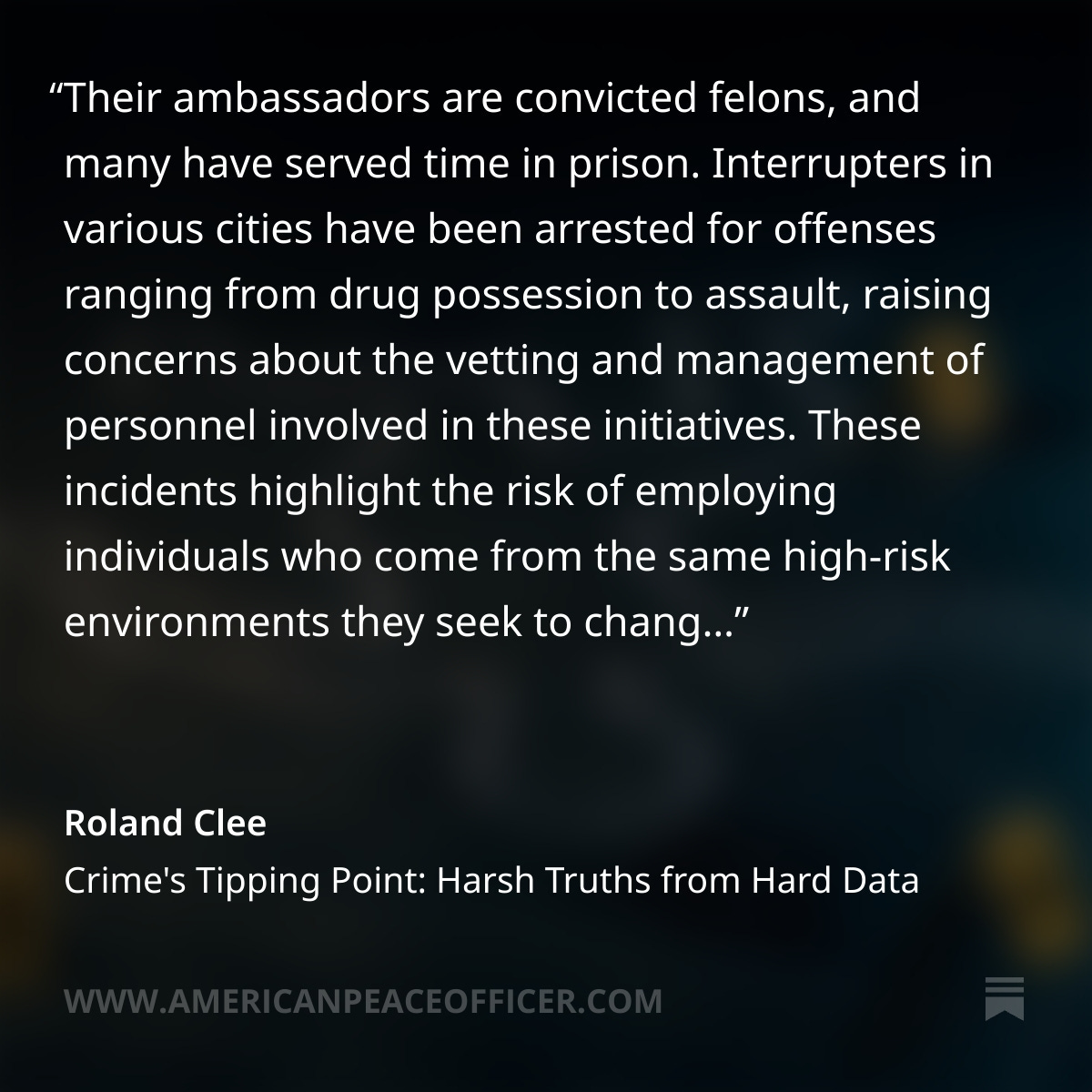
If you, like most rational people are observing that crime seems worse rather than better, you are correct. The news is still reporting local crime like it is off the charts. While we have an unnatural respite, the factors that will fuel the next wave are staring us in the face in the form of drug liberalization during an unprecedented national mental health crisis, partially caused by the psychosis inducing drugs themselves.
The crime decline narrative is seductive because it absolves people of responsibility. If crime is falling on its own, no one must answer for the catastrophic policy failures that cost hundreds of thousands of lives. Reality is less comforting. We are witnessing a temporary statistical lull shaped by attrition, demographic shifts, risk avoidance, and the long shadow of a drug crisis that devastated entire communities.
If anything, this moment demands more courage, more staffing, and more leadership—not less. The danger is not that crime numbers are down. The danger is that we deceive ourselves that this silence is safety and realize later that we dismantled the very institutions capable of stopping it.
Please keep all first responders and their families in your prayers!
Roland Clee served a major Florida police department as a Community Service Officer for more than 26 years. His career included uniformed patrol, training, media relations, intelligence, criminal investigations, and chief’s staff. He writes the American Peace Officer newsletter, speaks at public safety, recruiting and leadership conferences and helps local governments and public safety agencies through his business, CommandStaffConsulting.com.
His work is frequently featured on LawOfficer.com, the only law enforcement owned major media presence in the public safety realm.
For media interviews and podcast appearances, click here: http://bit.ly/40pT3NS
References:
https://www.fbi.gov/news/press-releases/fbi-releases-2024-reported-crimes-in-the-nation-statistics
https://abcnews.go.com/US/wireStory/homicide-rate-declines-sharply-dozens-us-cities-new-129445976
https://www.axios.com/2026/01/22/murder-rate-century-low
theatlantic.com/ideas/2026/01/great-crime-decline/685695/
https://www.cdc.gov/nchs/nvss/vsrr/drug-overdose-data.htm
https://www.cdc.gov/nchs/pressroom/releases/20250514.html
https://www.cdc.gov/nchs/fastats/drug-overdoses.htm
https://nida.nih.gov/research-topics/trends-statistics/overdose-death-rates
https://www.cdc.gov/overdose-prevention/about/understanding-the-opioid-overdose-epidemic.html
Crime's Tipping Point: Harsh Truths from Hard Data
(Thank you for being a valued subscriber to American Peace Officer! This publication has become the primary means of support for my family. By upgrading to a paid subscription, you'll do exactly what I do with the Substack creators I proudly support by investing in them. Your support ensures that I can continue delivering high-quality, ad-free content while expanding reach and impact.)
By far the most on point article I have read. I have been screaming these very issues and points for a few years now. All to no avail. So glad I hit that LinkedIn link yo read the full article. Great stuff.
Dead bodies & stolen cars.
yep. The only stats I trust.